It might be hard for the modern screenwriter to imagine what the pages of a Hollywood script circa 1920 might have looked like. After all, this was the era of Silent Film, which meant the story was not expressed through dialogue. The hero didn't speak to the villain. Only occasionally, in the middle column of the script, were type-print lines of "narration" or titles squeezed between the rows of action description. Below is an example from Anita Loos's 1916 script "Intolerance: Love's Struggle Throughout the Ages" directed by D.W. Griffith:

If these scripts only had the titles to set the stage and action was the only means of propelling their stories forward, how was the audience meant to become involved? The obvious, though not-so-obvious, answer is this: characters.

That's right Marilyn (as seen in the adaptation of Loos' Gentlemen Prefer Blondes.) Characters are the key.

But students of screenwriting (myself included) almost universally indulge in unnecessary dialogue. Frankly, it's a waste of script space. Writers of the early Hollywood Era, like Loos, implemented select adjectives and subtle behaviors to build the properties of their characters. Let's take a look:
The lead, Mrs. Jenkins, is an aging woman at a ball who loses a proposition to dance when a handsome man chooses a young girl over her.
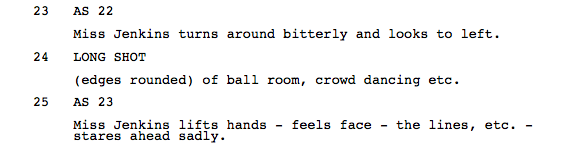
Note "bitterly" and "sadly," but also the premise. Competition, especially romantic competition, inherently produces joy or sadness, victory or defeat. The writer needs to clarify which character falls into which category.
Now, how does one individual react to a particular scenario? Not everyone will respond the same and that's what will make the character unique. If Loos went on to write "Miss Jenkins tilts up her chin and proudly exits the ballroom," that would obviously be a very different woman.
So we have premise and response. Let's look at two silent films and how they create tone with their characters, remembering that every action on screen was born from a word on the page.
First up, 1928's La Passion de Jeanne d'Arc starring Renee Jeanne Falconetti. The film, chronicling the conviction and execution of Joan of Arc, is regarded as pioneering for film production, directing, and acting. Though there are translated copies of the screenplay online, let's imagine, for our own sakes as writers, what adjectives these images might have corresponded to.
 |
| Stunned, Overcome, Aghast. |
 |
| Pensive, Absorbed, Sober. |
 |
| Accusatory, Disparaging, Critical. |
 |
| Fearful, Disturbed, Emotional. |
 |
| Accepting, Resigned, Enduring. |
Joan doesn't need to say a thing for the audience to understand her torturous predicament. The screenwriter simply defines the character's narrative arc with sharp, dramatic vocabulary.
On the other end of the spectrum is the choice of humorous language. Charlie Chaplin's 1921 comedy (or dramedy as we might refer to it now-a-days) The Kid is the story of an orphan boy whom the Tramp adopts and enrolls as his partner-in-crime. No script is available online but one can imagine that little Jackie Coogan's orphan is described as "confident," "mischievous," and "precocious." Chaplin's Tramp is usually a victim of circumstance or coincidence, but in the instance of The Kid he might be scripted as "scheming," "restless," and "agitated."
The combination of neurotic adult and assured child lead to the naturally comedic climax in the scene below.


